

Key points
- Most cavernous malformations (CCMs) happen by chance and do not run in the family. This is called a sporadic CCM.
- People with sporadic CCM most often have only one lesion.
- Relatives of a person with sporadic CCM are not at an increased chance to develop CCMs compared to other people.
Why Do Sporadic CCMs Develop?
Anyone can develop a CCM at any age due to combination of chance, genetic, and environmental risk factors. Researchers believe sporadic CCM lesions develop in a similar way to familial CCM:
- Small genetic changes occur in the blood vessel cells.
- These changes only happen in the CCM itself.
- Genetic testing typically has a negative (normal) result in people with just one CCM.
- They are not inherited and cannot be passed to children.
People may have a developmental venous anomaly (DVA), a type of vein variation that usually does not cause problems. A DVA can create conditions that make it more likely for a person to develop a CCM or multiple CCMs surrounding the DVA.
People who have had radiation treatment for brain cancer or tumors have a higher risk of developing CCMs because radiation can cause small changes in blood vessel cells.
How Magnetic Resonance Imaging (MRI) Helps Diagnose Sporadic CCM
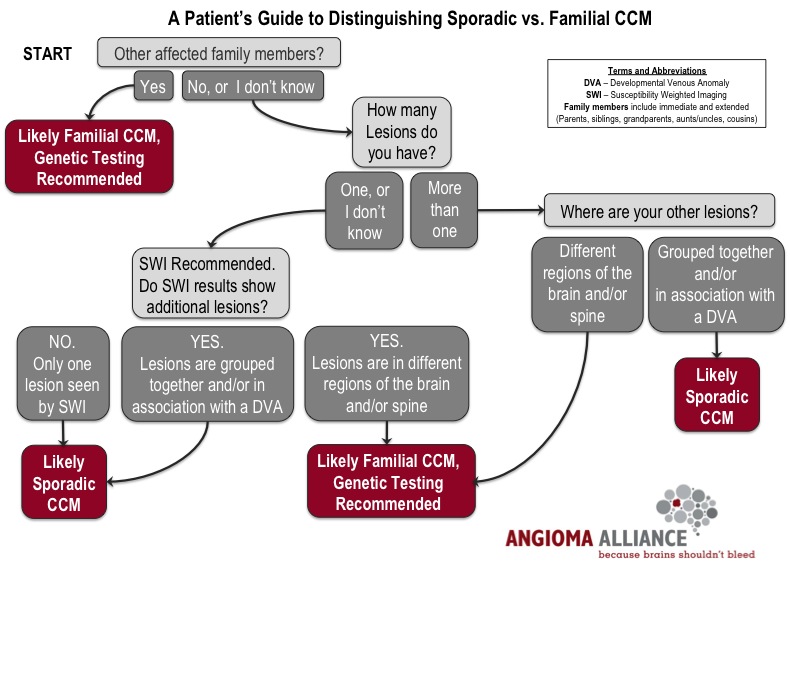
Susceptibility-weighted MRI (SWI) is a special type of MRI that can detect very small CCMs. Doctors often use SWI to help determine whether a person has sporadic CCM or familial CCM.
- People with sporadic CCM usually have one CCM, or a small number of CCMs near a developmental venous anomaly (DVA).
- People with familial CCM usually have many small lesions scattered throughout the brain.
SWI helps doctors look for these smaller lesions. If they are not present, it supports a diagnosis of sporadic CCM.
This information can help you and your doctor decide if genetic testing is neccessary.
Knowing that your CCM is sporadic may also reassure you that the condition cannot be passed on to your children.
Can Treatments for Familial CCM Help Sporadic CCM?
Research has shown that the same molecular changes seen in familial CCM also occur within individual sporadic CCMs.
This is good news because treatments being developed for familial CCM may also help people with sporadic CCM.
It is important to know if your CCM is sporadic or familial. This information helps:
-
You receive the most appropriate care and monitoring.
-
Your family understand their risks.
-
Doctors and researchers group patients correctly for clinical trials.
How You Can Help
You can play an important part in advancing CCM research:
- Talk to your doctor: Confirm your diagnosis and ask whether you have a developmental venous anomaly (DVA) or if SWI MRI has been done.
- Join the CCM Patient Registry: This keeps you updated on new studies you may be eligible for.
References
Awad IA, et. al. cavernous malformations: deconstructing and neurosurgical disease. Ju Neurosurg. 2019 July 1;131(1):1-13.
McDonald DA, et. al. Lesions from patients with sporadic cerebral cavernous malformations harbor somatic mutations in the CCM genes: evidence for a common biochemical pathway for CCM pathogenesis. Hum Mol Genet. 2014 Aug 15;23(16):4357-70.
Spiegler S, et. al. High mutation detection rates in cerebral cavernous malformation upon stringent inclusion criteria: one-third of probands are minors. Mol Genet Genomic Med. 2014 Mar;2(2):176-85.
Petersen TA et. al. Familial versus sporadic cavernous malformations: differences in developmental venous anomaly association and lesion phenotype. AJNR Am J Neuroradiol. 2010 Feb;31(2):377-82.
de Champfleur NM et. al. Magnetic resonance imaging evaluation of cerebral cavernous malformations with susceptibility-weighted imaging. Neurosurgery. 2011 Mar;68(3):641-7; discussion 647-8.
Last updated 3.14.26.