A doctor has just told you that you or a loved one has a cavernous malformation. It’s normal to have a lot of questions.
This page is for you if your doctor diagnosed you or a loved one with one or more cavernous malformations in your brain or spinal cord. Your doctor may have used the terms cerebral cavernous malformation (CCM), cavernoma, cavernous malformation, or cavernous angioma. These are all names for the same thing. On this page, we use the term cavernous malformation.
This page will help you understand the condition and make informed choices about your care. You may want to share this page with family members or others who care about you so they can better understand the condition.
Medical professionals: To request printed copies of this guide in booklet format, email info@alliancetocure.org.
Understanding CCM
What is a cavernous malformation?
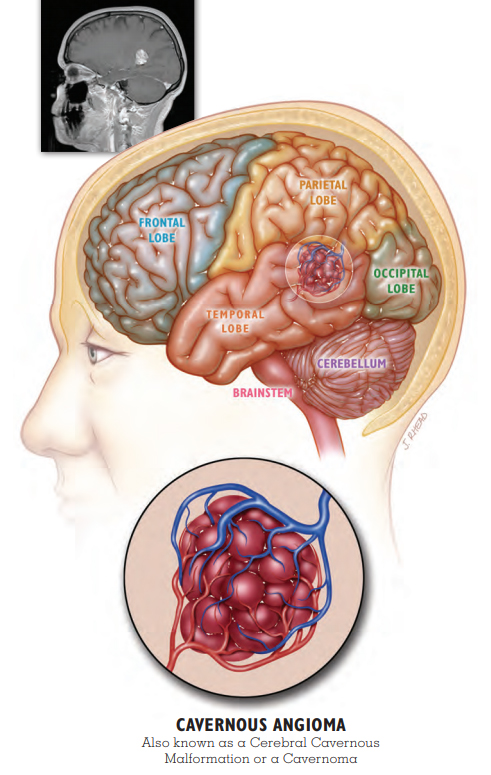
Cavernous malformations are made up of abnormal blood vessels. They are made of capillaries (the smallest blood vessels in the body). Blood moves through cavernous malformations very slowly. They look like raspberries and have very thin walls. Those thin walls can leak, and blood may enter nearby brain or spinal cord tissue. They are not cancerous but are sometimes called vascular tumors because they can grow.
About one in every 500 people has a cavernous malformation, but most never have symptoms.
Where they form
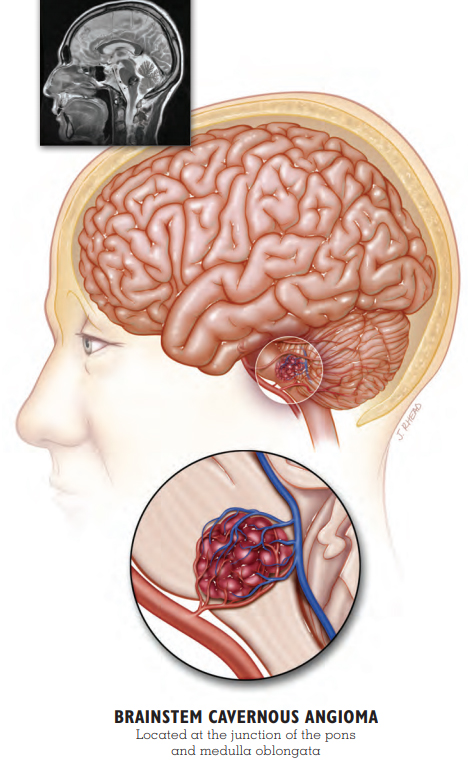
Most cavernous malformations occur in the cerebral lobes, the upper part of the brain. Cavernous malformations may also occur in the brainstem, the part of the brain that connects to the spinal cord. The spinal cord is the least common place for a cavernous malformation that causes symptoms. Cavernous malformations can cause severe symptoms and complications when they hemorrhage (bleed).
What symptoms can a cavernous malformation cause?
Symptoms from cavernous malformations vary from person to person. Location plays a large role, since different parts of the brain and spinal cord control different functions. Size and behavior matter too — a small, stable cavernous malformation is less likely to cause symptoms than a larger one or one that is actively bleeding. Some cavernous malformations cause no symptoms at all.
Common symptoms
Seizures are one of the most common symptoms, especially when a cavernous malformation is in the cerebral cortex (the outer layer of the brain), where seizures usually start.
Seizures caused by cavernous malformations usually start as focal seizures, which start in one area of the brain. Sometimes they affect both sides of the brain and become generalized. Doctors often use anti-seizure medications to control them. In some cases, if they know exactly which cavernous malformation is causing seizures, surgery or laser treatment may reduce or even stop seizures. Early surgery can help if medications do not work well. Cavernous malformations in the brainstem or spinal cord do not directly cause seizures.
Headaches are more common in people with cavernous malformations than in the general population. But headaches are very common in the general population, and a headache does not always mean a new bleed has occurred. A headache may be more concerning if it feels very different from your usual headaches or comes with new neurological symptoms.
Fatigue is common after a bleed or brain surgery. Some people feel tired for months or even years after a major bleed.
Sensation, pain, and movement changes can occur due to cavernous malformations in several different areas of the brain and spinal cord. Symptoms may include numbness, tingling, weakness, pain, spasticity, or foot drop.
Symptoms based on location
Cerebral lobes (frontal, parietal, temporal):
Cavernous malformations here may affect attention, memory, mood, social behavior, learning, or personality. This is more noticeable if someone has multiple cavernous malformations.
Occipital lobe:
Cavernous malformations here can affect vision and sometimes cause blind spots or other changes in sight.
Cerebellum:
The cerebellum helps control movement. Cavernous malformations here may cause balance problems, dizziness, nausea, or coordination difficulties (called ataxia).
Brainstem:
The brainstem controls many important body functions. Cavernous malformations here may cause:
Weakness or numbness on one side of the body
Facial weakness or paralysis
Double vision
Trouble swallowing
Coordination problems
Rarely, changes in breathing
Hiccup-like spasms that last more than a couple of days
Spinal cord:
Cavernous malformations here may cause:
Numbness, weakness, tingling, or burning sensations
When Ross was ten years old, he had his first seizure in the school yard and was rushed to the hospital, where he had two more seizures in the emergency department. Ross was diagnosed with epilepsy that day. Seizures reshaped Ross’s life in several ways, both big and small. He had to give up playing rugby due to the risk of head injury, and frequent seizures made it difficult to continue playing the other sports he loved. The side effects of his medications also impacted Ross’s academic performance in school. Doctors worked to identify a single lesion causing his seizures — but with multiple lesions and a rare CCM3 mutation, surgery has not been an option. Through it all, Ross found music. He picked up a guitar shortly after his diagnosis and earned a university degree in music and songwriting. Today, he is pursuing further education in Composing Music for Film, and he teaches guitar to young students in Dublin. Ross holds onto the hope that researchers will find a treatment for others living with active epilepsy.
What is an incidental cavernous malformation?
Your doctor may have discovered your cavernous malformation when you had brain or spinal imaging for another reason. For example, you may have had a scan after a car accident or concussion. When this happens, doctors call it an “incidental” finding.
Incidental cavernous malformations that have never bled have a very low chance of causing problems. You may not need repeat imaging unless your doctor recommends it or you develop symptoms.
Do I need follow-up care?
If you have a single incidental cavernous malformation, discuss ongoing care with your doctor. If the cavernous malformation is in an area of the brain that has a higher risk of bleeding or causing symptoms, such as the brainstem, your doctor may recommend continued follow-up. For others, the decision may be based on shared decision-making with your doctor.
If more than one cavernous malformation is found incidentally, it is a good idea to have regular follow-up visits with a doctor. This helps you maintain a relationship with a care provider in case you develop symptoms later.
Even though this can feel scary, it’s important to know that many stable lesions stay stable for years and never cause problems. Surgery is rarely used unless a lesion is causing symptoms, since surgery carries its own risks.
What is a sporadic cavernous malformation?
Most cavernous malformations happen by chance and are not passed down in families. These are called sporadic cavernous malformations.
People with this type usually have:
Only one cavernous malformation
No family history of the condition
Family members, including children, of a person with sporadic cavernous malformation are not more likely to have cavernous malformations than anyone else.
How doctors check
To check for this condition, your doctor may order an MRI scan with a special type of image called susceptibility-weighted imaging (SWI). This type of imaging can help doctors see smaller cavernous malformations. If no additional cavernous malformations are found on SWI, this is reassuring that the person likely has a sporadic cavernous malformation.
What causes multiple cavernous malformations?
Some people have more than one cavernous malformation. This can happen for a few reasons:
The most common reason is familial cavernous malformation. People with this condition are born with a higher chance of developing multiple cavernous malformations over time. Familial cavernous malformation is caused by a mutation (change) in the CCM1 (also called KRIT1), CCM2, or CCM3 (also called PDCD10) genes.
Some people develop multiple cavernous malformations after radiation therapy for brain cancer.
A developmental venous anomaly (DVA) (also called venous malformation) can also cause multiple cavernous malformations. The cavernous malformations usually form near the DVA in the same area of the brain.
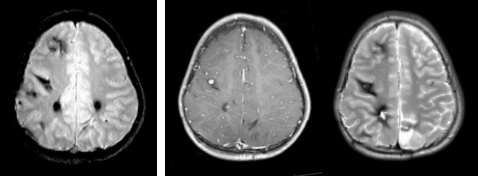
MRI with multiple cavernous malformations as seen on SWI (T2*), T1, and T2 sequences.
Patient Story: Vanessa
When Cavernous Malformations Cluster Around a DVA
Vanessa was two weeks into her second semester at fashion school in New York City when a brain bleed changed her life. An MRI traced the bleed to a cerebral cavernous malformation in her thalamus (a part of the brain that helps control movement and sensation), with two more nearby. All three lesions were clustered together around a developmental venous anomaly (DVA), which is not uncommon with cavernous malformations. The bleed caused hydrocephalus, a dangerous buildup of fluid in her brain, and within days Vanessa had emergency VP shunt surgery. It was the beginning of years of repeated bleeds, ER visits, and uncertainty.
Adapting to lasting changes
That first bleed left Vanessa with lasting disabilities, including dystonia (involuntary, painful muscle contractions) on one side of her body and severe ataxia, which causes shaking and coordination challenges. Together, these make walking and everyday tasks hard. Even so, Vanessa stayed committed to her goals. She continued her studies at a slower pace and graduated, walking at commencement with her cane.
A year later, another bleed made her symptoms worse, and she was no longer able to work. A few years after that, a new bleed caused facial paralysis that lasted two months, and her care team revisited the idea of surgery. Because Vanessa’s lesions are deep in the brain and the nearby DVA requires extra consideration during surgery, her options were limited. She chose laser interstitial thermal therapy (LITT), a less invasive laser procedure.
Vanessa today
Today, Vanessa lives with the daily challenges caused by her CCM. It has changed the course of her life, and the hard days are very real. Still, she keeps working toward her goals, including getting stronger through therapy and returning to work someday. She holds on to what she loves, from makeup artistry to travel and concerts, and has found steady support in the Alliance community. Giving up isn’t in her nature, so she keeps showing up for her life.
All cavernous malformations leak a small amount of blood very slowly. This is often called “oozing.” Oozing may not cause symptoms, but it gives cavernous malformations their typical “popcorn-like” appearance on an MRI scan.
Oozing is different from a symptomatic hemorrhage (bleed). A hemorrhage is more serious and can cause new or worsening symptoms.
A symptomatic hemorrhage is new bleeding in or around a cavernous malformation that leads to symptoms. This is the most serious problem linked to cavernous malformations and is the most common reason doctors may suggest surgery.
What affects symptoms
The symptoms a person has depend on:
Where the malformation is located
How big it is
How much blood has leaked
Some malformations only have slow oozing and may cause mild or no symptoms. Over time, leftover blood can break down and leave behind a substance called hemosiderin, which contains iron.
People with familial cavernous malformation often have more than one cavernous malformation. Each cavernous malformation has its own chance of bleeding. Having more cavernous malformations does not mean one is more likely to bleed, but it does mean there are more areas that could bleed over time.
Who is most at risk of bleeding
The biggest risk factors for bleeding are:
If the cavernous malformation has bled before
If the cavernous malformation is located in the brainstem.
Doctors often talk about bleeding risk in terms of yearly risk or five-year risk. Many cavernous malformations never cause a serious bleed. However, if a cavernous malformation has already bled once, the chance of another bleed is higher. The risk is greatest in the first five years after the first bleed, and then it slowly goes down over time and may return close to the level of cavernous malformations that have never bled. Very small cavernous malformations do not usually bleed.
Does anything increase my hemorrhage risk?
A bleed that causes new symptoms, also called a symptomatic hemorrhage, is the most serious problem that can happen with a cavernous malformation. About 1 in 4 people diagnosed with this condition will have at least one bleed.
Medicines and hormones
You may wonder if certain medications, like blood thinners, increase your risk. Current research shows that blood thinners do not seem to increase the risk of bleeding for most people. However, you should always talk with your healthcare provider before starting or stopping any medication.
Doctors recommend caution with hormone therapies that contain estrogen or progesterone. Some studies suggest these medicines may slightly increase the risk of bleeding. If you are thinking about using hormone therapy, talk with your doctor first.
Activities that do not raise risk
Research also shows that the following activities do not seem to increase the risk of bleeding:
Exercise like walking, running, or other aerobic activity
Non-contact sports
Flying on commercial airplanes
Moderate use of alcohol or caffeine
However, binge drinking should be avoided, and alcohol use should be discussed with your healthcare provider based on your personal health.
For the most up-to-date information, visit the hemorrhage section of the Alliance to Cure Cavernous Malformation website. If you have questions about your own risk, talk with your healthcare provider. They can help you understand what is best for your situation.
Patient Story: John
Living with a Spinal Cavernous Malformation
John had already lived with a cavernous malformation diagnosis for four years when he boarded a flight home from a family trip. His brainstem CCM had bled once, leaving him with symptoms that improved over months but never fully resolved. He had learned to live with them.
On the way home, he started to feel like something was wrong with his legs. By the time the plane landed, he couldn’t walk without using his suitcase as a crutch. “We went straight to Massachusetts General Hospital, where I was helped into a wheelchair. That is the last time I stood up.”
A second bleed
Doctors confirmed a second bleed, this time in his spinal cord. As a familial CCM patient, John knew multiple lesions came with the territory. He just didn’t know one of them was in his spine. Two days after that flight, he was completely paralyzed from the waist down. He spent two months between the hospital and a rehabilitation center before returning home.
John today
Life looks different now, but it is still full. John has found a love for adaptive sailing. He spends time with his family, and his grandkids bring him particular joy. And he joined the Board of the Alliance to Cure Cavernous Malformation, channeling his experience into raising awareness and pushing toward a cure. Other lesions remain, and the possibility of another bleed is always present. But John has chosen to meet that uncertainty with action.
Several healthcare professionals may help care for you. The type of doctors and therapists you will see will depend on your symptoms and needs. Your care team may include:
Brain and spine doctors
Neurologist – A doctor who treats brain and nerve conditions. They help manage symptoms such as seizures, headaches, weakness, or pain.
Neurosurgeon – A doctor who performs surgery on the brain and spine. They evaluate whether surgery may help remove a cavernous malformation or treat seizures.
Rehabilitation and therapy
Physiatrist (Physical Medicine and Rehabilitation Doctor) – A doctor who helps people regain strength, movement, and function after a brain or spinal cord problem.
Therapists – These specialists help with recovery and daily activities. They may include:
Physical therapists (movement and strength)
Occupational therapists (daily activities such as dressing or writing)
Speech therapists (speech, swallowing, social, and language skills)
Vision or vestibular therapists (vision and balance)
Mental health therapy providers (emotional support and coping)
Other specialists you may see
Neuropsychologist – A specialist who tests and evaluates thinking, memory, learning, and emotions.
Psychiatrist – A doctor who diagnoses and treats mental health conditions.
Neuro-ophthalmologist – A doctor who diagnoses and treats vision problems related to the brain.
Geneticist or Genetic Counselor – Specialists who evaluate whether a condition may run in your family. They also help families understand genetic testing and what the results mean.
Dermatologist – A doctor who examines skin changes that can sometimes occur with the hereditary form of this condition.
Orthopedist – A doctor who treats bones, joints, and the spine. They may monitor spine problems and help with mobility concerns.
Perinatologist (Maternal-fetal medicine) – A doctor who manages high-risk pregnancies.
What should I ask my doctor?
Bring a written list of questions and mark your top 3–5. This helps the doctor answer the most urgent concerns first. You can always ask the remaining questions in later appointments or via the patient portal/email.
Top Priority (Ask at your next visit)
These questions give you the most important information about your condition and immediate risks.
How big is the cavernous malformation?
How many cavernous malformations do I have?
Where exactly is the cavernous malformation?
Does the cavernous malformation show signs that it has bled before?
What symptoms should I watch for that would require calling you or going to the ER?
Secondary Priority (Ask if time allows or at follow-up visits)
These help you plan long-term care and understand potential treatments.
What functions does this part of the brain control?
Is there a developmental venous anomaly (DVA) near the cavernous malformation?
If I have another bleed, what symptoms should I expect?
When would you recommend surgery?
Follow-up and monitoring
How often should I follow up with you?
How often will I need follow-up tests, and which tests will I have?
We will explore some of these questions in the following sections.
How often do I need an MRI?
This is an important topic to discuss with your doctor. Some doctors recommend having MRI scans regularly. Others suggest waiting until new symptoms appear before doing another scan.
Experts often suggest more frequent imaging for people who may not be able to explain their symptoms, such as young children or those with thinking or communication challenges. These patients may need sedation to help them stay still during an MRI. You and your doctor will need to weigh the risks of sedation against the benefits of getting clear images.
MRI or CT scan?
A CT scan is another type of imaging test. CT scans are faster than MRIs, but they do not show as much detail and use a small amount of radiation. CT scans can be helpful in emergencies to quickly check for serious problems, like bleeding in the brain, especially if an MRI is not available right away. When imaging is needed quickly to help make treatment decisions, the benefits of a CT scan are greater than the small risk from radiation.
High doses of radiation to the brain, such as those used to treat some cancers, have been linked to the later development of cavernous malformations. The amount of radiation used in a CT scan is much lower.
Do I need surgery?
If a cavernous malformation is causing symptoms, you should talk carefully with a neurosurgeon about whether surgery is an option. Deciding on surgery means weighing the possible risks and benefits. Surgery is not recommended for an asymptomatic cavernous malformation that has never caused symptoms or bleeding.
The most common treatment is open surgery. This is called a craniotomy when it involves the skull, or a laminectomy when it involves the spine. Surgery is usually considered after a second bleed or if the condition is causing seizures (epilepsy).
For some patients with epilepsy, newer, less invasive procedures may be an option instead of traditional open surgery.
Finding the right surgeon
Some neurosurgeons specialize in cerebrovascular (brain blood vessel conditions) and skull base (brainstem) surgery. It is important to learn about your surgeon’s experience with cavernous malformations. Getting a second opinion may be helpful, especially from a designated CCM Center of Excellence or CCM Clinical Center.
Patient Story: Joyce
A CCM1 Journey
In 2004, Joyce learned that she had multiple cavernous malformations in her brain and spine. After genetic testing, her doctors told her that a mutation in the CCM1 gene is the cause. This specific change is known as the Common Hispanic Mutation (scientific name: CCM1 c.1363C>T, p.Q455*).
People of any background can have familial cavernous malformations. Sometimes, families who are connected through a distant ancestor share a mutation. This is called a founder mutation. The families with the CCM1 Common Hispanic Mutation can trace their roots to early Spanish settlers in New Mexico. Many of these families still live in New Mexico today. In fact, more people with cavernous malformation live in New Mexico than anywhere else in the world.
Raising awareness in New Mexico
Joyce spent 15 years identifying the founding families of the mutation in New Mexico. Joyce works to raise awareness across New Mexico by speaking at patient conferences and public workshops. She shares her story with local and national media. She also supported legislation to educate more doctors about cavernous malformations in the state of New Mexico, leading to dedicated funds for research and care at the University of New Mexico.
Joyce today
Joyce has not been symptom-free. She had spinal surgery shortly after her diagnosis. Other cavernous malformations have had new and worrisome effects. She has been hospitalized from time to time. So far, she has not had another surgery. Joyce does not let the disease slow her down.
One of Joyce’s biggest reliefs is that her children did not inherit the condition. Still, Joyce continues her advocacy to support the many New Mexicans who continue to face challenges. “It helps a patient to become their own advocate,” Joyce said. “Once people start talking to each other, it doesn’t seem so scary.”
Are other treatments for cavernous malformation available?
Radiosurgery
Doctors have used a treatment called stereotactic radiosurgery for many years to treat cavernous malformations. This treatment is also known as Gamma Knife, CyberKnife, or other similar names. It uses focused radiation aimed at the malformation without opening the skull.
However, it is still not clear how well this treatment works. Because of this, experts recommend using radiosurgery only in certain cases. It may be an option for people who have one symptomatic cavernous malformation in a part of the brain where regular surgery would be too risky.
Radiosurgery is not advised for people with the familial form of cavernous malformation. In these cases, it is believed the radiation could cause new cavernous malformations to form.
New medicines being studied
Researchers are working to find medications that can treat cavernous malformations. It is likely that more than one type of medicine will be needed. In the future, medications may help:
Keep a cavernous malformation stable so it does not bleed.
Lower the risk of another bleed after one has already happened.
Slow or stop new cavernous malformations from forming in people with familial cavernous malformation.
Shrink or possibly destroy existing malformations.
Other ways to manage symptoms
Not everyone with a cavernous malformation is a candidate for surgery. That doesn’t mean there’s nothing that can be done — medicines can help manage symptoms like seizures or spasticity (tight, stiff muscles that are hard to move), and therapies such as physical, occupational, vision, balance, or mental health support can improve daily life.
Should I get genetic testing?
About 80% of cavernous malformation cases happen by chance. These are called sporadic cases. The other 20% are familial, which means they run in families.
For people with only one cavernous malformation and no family history of the condition, genetic testing usually comes back normal, meaning no gene change linked to the condition is found. Because of this, genetic testing is most often recommended for people with more than one cavernous malformation or for those with a family history of cavernous malformations.
Who should consider testing
People who have multiple cavernous malformations should consider genetic testing. In some cases, a person may be the first in their family to have the condition. This means you do not need to have other affected family members to consider testing. It’s also possible for multiple cavernous malformations to form near a DVA (developmental venous anomaly) — in that case, it’s typically not genetic, so genetic testing may not be needed. You can learn more about DVAs in the What causes multiple cavernous malformations? section above.
What results mean for your family
Genetic testing can help find the exact genetic change that is causing the condition in a family. Once this is known, other family members (such as parents, siblings, children, and even extended relatives) can be tested to better understand their own risk.
This information can also help with family planning and may allow people to take part in research studies. In the future, there may be treatments designed for specific genetic changes.
Should I have concerns about pregnancy with a cavernous malformation?
Women with cavernous malformations are not believed to be at increased risk for bleeding in the brain or spinal cord during pregnancy. In most cases, they can have a vaginal delivery, especially if they have not had a recent bleed. However, it is important to talk through these decisions carefully with your doctors.
Imaging and medicines during pregnancy
If your doctor recommends an MRI during pregnancy, it should be done without a contrast dye called gadolinium.
Women who have seizures and take anti-seizure medications should talk with their doctors about whether their medicines need to be changed during pregnancy. Care decisions should be made with your medical team, which may include a perinatologist (high-risk pregnancy specialist).
If a cavernous malformation bleeds during pregnancy, it can make treatment more complicated. In some cases, surgery may still be needed during pregnancy if waiting until after delivery would be too dangerous.
Are there special issues for children with a cavernous malformation?
Young children may not always be able to explain their symptoms, so doctors often rely on regular checkups and imaging over time. It’s also important not to overdo testing — trusting your instincts and working with an experienced medical team can help you find the right balance. As children grow older, they’re better able to describe how they feel, and parents often become more confident managing the condition over time.
Learning and school support
A cavernous malformation can affect learning, attention, or behavior, especially after a bleed or surgery. A neuropsychologist (a specialist in brain function) can evaluate your child’s strengths and challenges and help guide support at school, at home, and in the community. If your child is struggling in the classroom, ask your school about an IEP (Individualized Education Program) or a 504 Plan — these are formal plans that can provide accommodations like extra time, breaks, or modified assignments.
Talking with your child
Talking to your child about their diagnosis can be emotional, and it may take time for them to understand and adjust. Try to explain things in simple, age-appropriate ways. A social worker or pediatric mental health professional can make these conversations easier and help your child adjust to changes in behavior, activity limits, or questions about sports and physical activity.
You may need to explain your child’s condition many times — to teachers, school staff, coaches, friends, and other caregivers. Connecting with other parents through the Alliance to Cure community can help, since many have experience navigating similar conversations.
Patient Story: Kathryn
Brainstem CCM in Childhood
At seven years old, Kathryn was helping her family sell Girl Scout cookies when her mom, Amber, noticed something was wrong. Kathryn’s smile had gone lopsided, she was stumbling over simple math, and when Amber asked her to close her eyes and hold her arms out, her right arm dropped. Amber recognized the signs of a stroke immediately and got her to the emergency room. Scans found the cause: a cavernous malformation in her brainstem that had bled, and Kathryn needed surgery.
Getting expert opinions
Because of where the lesion was, it was a tricky case, and the family got opinions at two of the Alliance’s CCM Centers: Lurie Children’s Hospital in Chicago and Barrow Neurological Institute. They had a great experience at both, with each team offering honest, genuinely helpful advice as the family worked through the best path forward for Kathryn. They ultimately decided to move forward with surgery at Barrow, where the surgical care was excellent. Dr. Michael Lawton removed the lesion, and Kathryn came through brainstem surgery without any new neurological deficits.
Kathryn today
Recovery has not been easy, and Kathryn continues to face some ongoing challenges, including weakness on her right side. But she’s back to being a kid: dancing, playing violin, doing Girl Scouts, and playing volleyball and softball, pushing through frustration on the days she can’t quite keep up with her teammates. “We can do hard things” has become something of a family motto. Her family is grateful for the guidance and the surgical skill that CCM Centers brought to Kathryn’s care.
Are there any lifestyle changes that may reduce risk?
While researchers work toward a cure, there are some things you can do now that may help lower your risk:
Vitamin D
Inflammation can make cavernous malformations worse. Vitamin D helps reduce inflammation and supports your immune system. Studies show that low vitamin D levels may be linked to a more serious course of the disease. Your doctor can check your vitamin D with a simple blood test. If your levels are low, your doctor can recommend the right vitamin D supplement.
Diet
Research shows that the gut microbiome (the bacteria in your digestive system) may affect cavernous malformations. Protect your gut by avoiding foods with emulsifiers and artificial preservatives. Cutting back on processed foods is a good place to start.
Other health habits
If you smoke or vape, try to stop.
Avoid binge drinking.
Stay up to date on vaccinations, like the flu shot and COVID-19 vaccines.
Keep your heart and blood vessels healthy.
Manage stress as best you can.
Are there other ways I can be safer?
It’s a good idea to keep some of your medical records handy, especially when you travel or in case of an emergency. Make sure your emergency contacts understand what a cavernous malformation is and your medical history.
You might also consider:
Wearing a medical alert bracelet that says you have a condition that can cause bleeding in the brain or spinal cord.
Using a smartphone app to share important medical information with doctors or emergency personnel.
How do I cope?
A diagnosis of cavernous malformation can feel overwhelming. Everyone needs time to adjust to a “new normal.” This may include grieving the changes in your life.
A counselor or mental health professional can help if your emotions make it hard to manage daily life. Friends and family may not always understand, especially if you don’t appear sick.
Connecting with others
Alliance to Cure Cavernous Malformation is a great resource for you and your family. You can meet other patients and families and learn more about the condition. In addition, the Alliance to Cure Cavernous Malformation has a growing online community and weekly virtual support groups where you can meet others who share your experiences. We are committed to supporting each other.
Hope for the future
Living with a cavernous malformation can be hard, but there is hope. New treatments are being studied that may help reduce symptoms and lower the risk of bleeding.
Research studies
Research studies are already testing medicines and other treatments. Some of these trials focus on less invasive or non-invasive techniques.
You can find more information about joining these studies and learning about new treatments on our website. Research is ongoing to develop better treatments and, one day, a cure.
Connect with other patients and families in our online community and weekly virtual support groups.
About this information
Our mission is to inform, support, and bring together people affected by cavernous malformation. We also work to advance research for better treatments and a cure.
Alliance to Cure Cavernous Malformation offers:
Patient information and resources
Support for patients and families
Genetic testing opportunities
Ways to participate in research
We also host an annual International Scientific Meeting and provide research grants to help scientists study cavernous malformations.
The information on this page is based on clinical care guidelines written by the Clinical Advisory Board Experts Panel.
Disclaimer: This page is for educational purposes only and does not replace medical care. Nothing on this page should be taken as medical advice, diagnosis, or treatment. Always talk with a qualified healthcare provider about medical questions or treatment decisions. Medical knowledge changes over time, so please check back here or with other trusted sources for the most current information.
This website uses cookies to improve your experience. We'll assume you're ok with this, but you can opt-out if you wish. Cookie settingsPrivacy PolicyACCEPT
Privacy & Cookies Policy
Privacy Overview
This website uses cookies to improve your experience while you navigate through the website. Out of these cookies, the cookies that are categorized as necessary are stored on your browser as they are essential for the working of basic functionalities of the website. We also use third-party cookies that help us analyze and understand how you use this website. These cookies will be stored in your browser only with your consent. You also have the option to opt-out of these cookies. But opting out of some of these cookies may have an effect on your browsing experience.
Necessary cookies are absolutely essential for the website to function properly. This category only includes cookies that ensures basic functionalities and security features of the website. These cookies do not store any personal information.
Functional cookies help to perform certain functionalities like sharing the content of the website on social media platforms, collect feedbacks, and other third-party features.
Performance cookies are used to understand and analyze the key performance indexes of the website which helps in delivering a better user experience for the visitors.
Cookie
Duration
Description
AWSALB
7 days
AWSALB is an application load balancer cookie set by Amazon Web Services to map the session to the target.
Analytical cookies are used to understand how visitors interact with the website. These cookies help provide information on metrics the number of visitors, bounce rate, traffic source, etc.
Cookie
Duration
Description
_ga
1 year 1 month 4 days
Google Analytics sets this cookie to calculate visitor, session and campaign data and track site usage for the site's analytics report. The cookie stores information anonymously and assigns a randomly generated number to recognise unique visitors.
_ga_*
1 year 1 month 4 days
Google Analytics sets this cookie to store and count page views.
_hjSession_*
1 hour
Hotjar sets this cookie to ensure data from subsequent visits to the same site is attributed to the same user ID, which persists in the Hotjar User ID, which is unique to that site.
_hjSessionUser_*
1 year
Hotjar sets this cookie to ensure data from subsequent visits to the same site is attributed to the same user ID, which persists in the Hotjar User ID, which is unique to that site.
_hjTLDTest
session
To determine the most generic cookie path that has to be used instead of the page hostname, Hotjar sets the _hjTLDTest cookie to store different URL substring alternatives until it fails.
ahoy_visit
4 hours
This cookie is set by Powr for analytics measurement.
ahoy_visitor
2 years
This cookie is set by Powr for analytics measurement.
Advertisement cookies are used to provide visitors with relevant ads and marketing campaigns. These cookies track visitors across websites and collect information to provide customized ads.
Cookie
Duration
Description
VISITOR_INFO1_LIVE
6 months
YouTube sets this cookie to measure bandwidth, determining whether the user gets the new or old player interface.
VISITOR_PRIVACY_METADATA
6 months
YouTube sets this cookie to store the user's cookie consent state for the current domain.
YSC
session
Youtube sets this cookie to track the views of embedded videos on Youtube pages.
yt-remote-connected-devices
never
YouTube sets this cookie to store the user's video preferences using embedded YouTube videos.
yt-remote-device-id
never
YouTube sets this cookie to store the user's video preferences using embedded YouTube videos.
yt.innertube::nextId
never
YouTube sets this cookie to register a unique ID to store data on what videos from YouTube the user has seen.
yt.innertube::requests
never
YouTube sets this cookie to register a unique ID to store data on what videos from YouTube the user has seen.